
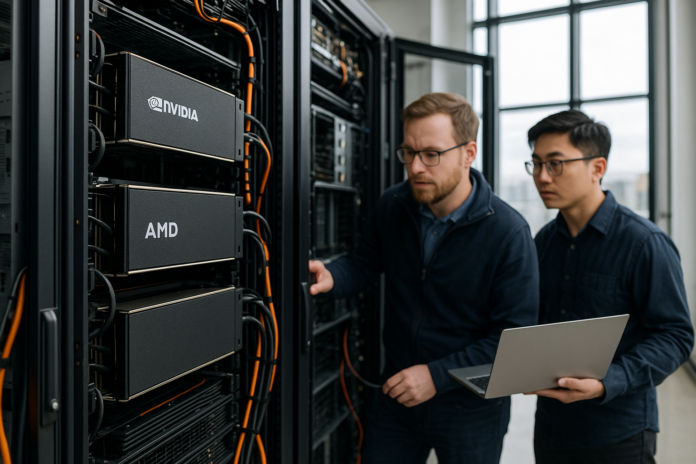
As artificial intelligence adoption accelerates across sectors, cost-effective local AI deployment faces new hurdles. The core of this challenge lies in VRAM economics: how the cost, supply, and capacity of video RAM in GPUs dictate both feasibility and sustainability of AI infrastructure. While the global AI race draws headlines with government initiatives and large-scale chip deliveries — such as the UAE’s strategic import of elite NVIDIA processors — the nuanced economics at play are equally critical in markets like Canada, where cost control and local privacy are key priorities.
Understanding VRAM Economics in AI Hardware Cost
VRAM, or Video Random Access Memory, is the lifeblood of contemporary AI workloads. It holds neural network weights, activations, datasets, and intermediate processing states during model inference and training. The greater the capacity, the larger or more complex the AI model that can be run. However, as demand for AI accelerates, so do GPU pricing trends, with hardware from NVIDIA, AMD, and even network partners like Mellanox, reaching unprecedented price points.
Recent GPU launch cycles, such as the NVIDIA RTX 30 Series and AMD Radeon Pro product lines, consistently push the upper edge of price-per-gigabyte for VRAM. Unlike commodity system memory, VRAM is tightly integrated with GPU dies, carries specialized engineering constraints, and suffers from supply chain volatility. For Canadian enterprises and institutions prioritizing local AI infrastructure, this makes scaling up far from trivial.
GPU Pricing Trends and Their Impact on Local AI Infrastructure
The pandemic-era GPU shortages and the ongoing AI boom have together driven up hardware costs for everyone, not just hyperscale data centers. Canadian companies, governments, and research institutes committed to keeping sensitive data on local soil now face a real bottleneck: the high cost of VRAM-rich GPUs compared to the ever-increasing memory requirements of state-of-the-art AI models.
- The unit price of high-VRAM GPUs is outpacing other server components, transforming local AI deployments from a fixed one-off acquisition into an ongoing budgetary strain.
- Marketplace dynamics—NVIDIA’s dominant position, AMD’s gradual gains, and the influence of interconnect solutions like Mellanox—create further barriers to competitive pricing.
- Buying cycles and inventory planning are often dictated by the VRAM capacities available in major product releases, not by local organizational need.
This economic dynamic is visible not only in government and enterprise, but also among research partnerships, startups, and AI labs aiming to stay competitive without offshoring data. As a result, AI hardware cost has become synonymous with the economics of VRAM itself.
The Skeptical Case: The Limits of Scale in VRAM-Driven AI Hardware
While cloud providers tout economies of scale, the reality for many local deployments is nuanced and sometimes skeptical. GPU price hikes have not been mitigated by increased volume or usage, especially at the cutting edge where high VRAM requirements isolate buyers from affordable options.
This skepticism is compounded by:
- Escalating VRAM needs for modern transformer models and generative AI agents, outpacing even the most capacious NVIDIA RTX or AMD Radeon Pro cards.
- Lack of true alternatives: CPUs with large shared memory offer neither the raw parallelism nor the ecosystem support of GPUs. Custom ASICs are rare, expensive, and typically not designed for general AI workloads.
- Persistent premium pricing due to high demand and slow yield improvements, especially for the latest manufacturing nodes used in leading GPU and memory products.
Exploring Alternatives to GPU-Based VRAM for AI
For Canadian organizations, two alternative pathways have started to gain attention, though both have practical hurdles:
- Clustered deployments: By spreading jobs across multiple smaller GPUs or nodes, some flexibility can be gained, but this comes at software complexity and networking costs, often requiring high-speed interconnects such as Mellanox Infiniband.
- Emerging AI accelerators: Companies are experimenting with non-GPU hardware promising optimized memory architectures. However, most remain niche products with limited software support outside highly specialized workloads.
The industry sentiment remains that, for general-purpose, locally controlled AI deployment, the economics of VRAM will continue to shape the budgeting and technical landscape.
Conclusion: Rethinking Local AI Infrastructure Amid VRAM Realities
VRAM economics are now a defining force in the Canadian AI hardware landscape. As AI models grow, so do the demands on GPU memory — and therefore the cost and feasibility of building and expanding local AI capabilities. While cloud alternatives provide some relief, many organizations see private infrastructure as non-negotiable.
For those planning or scaling local AI deployment, a clear-eyed understanding of VRAM-driven costs, GPU pricing trends, and possible alternatives is essential to stay competitive and sustainable without relying solely on global supply swings or vendor roadmaps.
FAQ: VRAM Economics and Local AI Deployment
- What is VRAM and why does it matter?
VRAM, or Video Random Access Memory, is a specialized type of memory used by GPUs for AI tasks. The available VRAM limits the size and complexity of models you can run on local hardware. - How does VRAM affect the cost of local AI deployment?
Higher VRAM GPUs are significantly more expensive, driving up the overall cost of deploying AI infrastructure locally, especially for newer or larger models. - Are there alternatives to GPU-based VRAM for AI?
Some alternatives exist, such as CPUs with large system RAM or emerging AI accelerators, but these often involve trade-offs in speed, support, or price compared to mainstream NVIDIA and AMD solutions.