
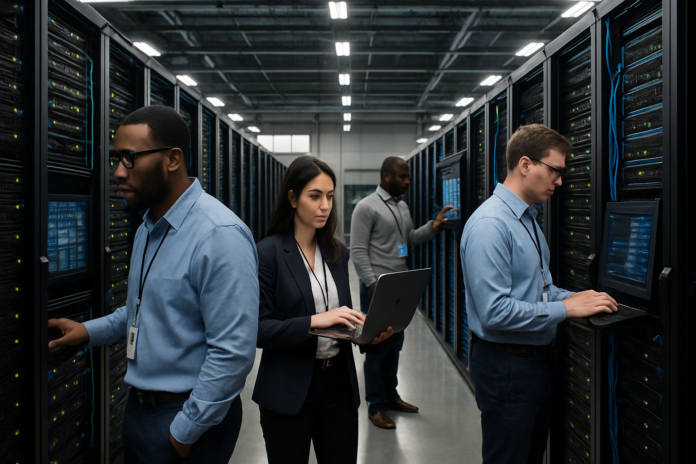
The joint TPU cloud venture between Google and Blackstone marks a significant evolution in AI hardware investment, promising broad economic impact for the Canadian AI ecosystem and the advancement of local cloud infrastructure.
TPU Cloud Venture: A New Paradigm in AI Hardware Investment
With Google’s technical leadership in artificial intelligence and Blackstone’s $5 billion capital commitment, their TPU cloud venture targets a growing demand for advanced data center capacity. Google’s Tensor Processing Units (TPUs), as proprietary AI accelerators, are engineered to outperform traditional hardware for AI and machine learning workloads. This partnership unlocks large-scale access to Google’s cutting-edge silicon, intensifying competition with NVIDIA, AMD, Intel, and Mellanox in the global AI hardware marketplace.
For Canadian stakeholders, this initiative is particularly significant. Canada’s status as a world leader in AI research and commercialization means local companies, startups, and universities are positioned to leverage high-powered TPU-driven cloud services for advanced workloads in natural language processing, computer vision, and decision intelligence. The easier availability of next-generation hardware will likely attract additional research funding, international partnerships, and talent to Canadian tech hubs.
Economic Impact on the Canadian AI Ecosystem
Canada has invested heavily in building a globally recognized AI ecosystem, supported by research hubs in Toronto, Montreal, Edmonton, and Vancouver. The arrival of scalable, high-performance TPU cloud solutions can accelerate time-to-market for new AI applications, boosting the competitiveness of Canadian startups and established firms alike. Companies previously reliant on costly, on-premises infrastructure or competition for scarce NVIDIA GPUs now have alternative pathways to scale application training and inference pipelines.
Increased access to specialized hardware also feeds into the development of applied research, enabling projects in health sciences, financial services, and climate modeling that require vast computational resources. As AI hardware becomes more accessible through cloud platforms, we can expect secondary economic benefits, including job creation in data center management, cybersecurity, and operational technology maintenance.
- Broader hardware choice: Reducing dependence on a narrow set of GPU suppliers such as NVIDIA and AMD, while encouraging diversification in AI acceleration technology.
- Data sovereignty: Local enterprises and public sector AI projects can access advanced hardware while maintaining compliance with Canadian data residency regulations.
- Spurring local investment: The potential ripple effect extends to local infrastructure investment, stimulating demand for more robust cloud connectivity, secure data warehousing, and edge AI deployments.
Strategic Opportunities for Canadian Cloud Infrastructure
As international ventures like Google and Blackstone’s gain traction, Canadian data center providers and infrastructure integrators stand to benefit through partnerships, technical training, and expanded service offerings. Support industries—ranging from cybersecurity providers, such as those aligned with the Canadian Centre for Cyber Security, to suppliers of high-speed networking and energy-efficient cooling technologies—may see increased demand as the need for operational resilience and risk management grows.
The anticipated influx of new cloud infrastructure capacity creates fertile ground for innovation, allowing AI startups and established companies to experiment and iterate faster, lower their hardware procurement risks, and capture new market segments. Locally, this could translate to enhanced global competitiveness for Canadian AI companies and a new set of opportunities for economic diversification in the broader technology sector.
FAQ: Economic Implications of Google and Blackstone’s TPU Cloud Venture
- What is the economic significance of Google and Blackstone’s TPU venture?
The TPU cloud venture represents a $5 billion investment in scalable AI hardware and cloud infrastructure, setting a new benchmark for capital inflow into advanced data centre capacity. By increasing access to Google’s proprietary TPU chips, this initiative is poised to drive economic growth, fuel AI research and development, and attract further global investment in regions with a strong AI ecosystem, such as Canada. - How will this partnership affect Canadian AI companies?
Canadian AI companies are likely to gain improved access to state-of-the-art cloud-based TPU hardware, which can reduce reliance on NVIDIA, AMD, and other established providers. This increased accessibility allows startups and established firms to scale experiments, accelerate product development, and compete globally. The move could also spark further AI hardware investment in Canada. - What opportunities are available for local AI infrastructure?
The TPU cloud venture paves the way for Canadian data center providers, integrators, and infrastructure startups to partner with or support such large-scale cloud deployments. There are increased opportunities for collaboration, skill development, and the growth of supporting operational technology and cybersecurity services.
Conclusion
The TPU cloud venture initiated by Google and Blackstone is more than a substantial financial commitment; it is a catalyst for reshaping the economic landscape of AI infrastructure in Canada. As access to elite hardware becomes democratized, Canadian organizations will be better equipped to lead in AI-driven innovation, harnessing the benefits that robust cloud and operational technology ecosystems can provide. For government, business, and academia, the strategic opportunities and competitive edge afforded by this new hardware era are clear signs of the sector’s momentum—and Canada’s pivotal place within it.