
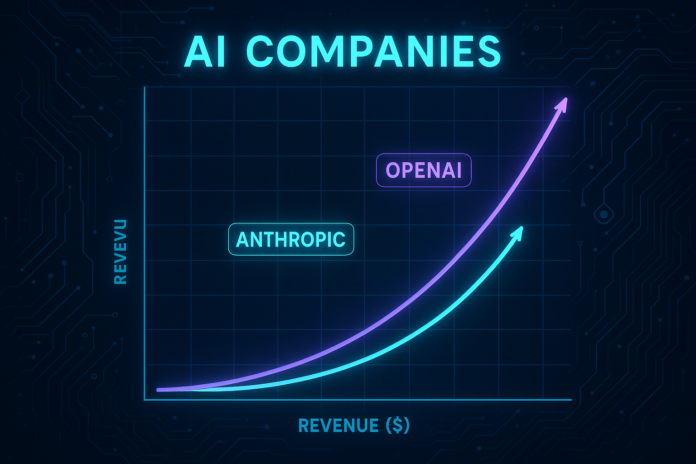
Recent reports have highlighted the extraordinary revenue growth figures posted by leading AI startups Anthropic and OpenAI. Both companies have spotlighted significant jumps in their top-line results in a short span, prompting questions about how these metrics are calculated and the broader implications for the AI sector.
Last month, OpenAI revealed that its annualized revenue had climbed to approximately $25 billion, nearly quadrupling what it recorded just one year earlier. This striking acceleration underscores the massive demand for AI technologies, especially in language models and AI services that these firms provide.
The surge is not just a function of underlying market expansion but also how these companies tally their revenues. Their reported figures often incorporate a combination of realized sales, contract values, and recurring revenue streams from enterprise clients. Such approaches to revenue recognition bring to light important nuances in understanding their financial performance versus pure cash flow metrics.
Anthropic, another prominent AI player, is also witnessing rapid revenue growth, riding the wave of market interest and investment in advanced AI models. While exact numbers remain less public, insiders note that Anthropic employs similar strategies in aggregating its revenue to convey strong growth trends.
The intense focus on revenue milestones reflects the heightened competition and investor appetite within the AI startup ecosystem. Rapid growth narratives help secure further funding rounds and strategic partnerships, while also setting high expectations for future innovation and commercial deployment.
However, analysts caution that these headline revenue figures need contextual interpretation. The methods used to calculate them — including annualizing partial-year contracts or projecting client commitments — can inflate short-term perceptions of financial scale. Investors and stakeholders must balance enthusiasm with rigorous due diligence to accurately assess company health.
In the broader AI market, this dynamic hints at an evolving landscape where startups deploy aggressive growth accounting to underscore their value propositions. As both Anthropic and OpenAI continue to refine and release new AI solutions, their revenue trajectories will remain key indicators of sector momentum and the commercial viability of artificial intelligence.
For Canadian AI observers, these developments mirror global trends impacting domestic AI ventures, underscoring the importance of clear financial communication and sober interpretation of growth figures in a rapidly shifting industry.