
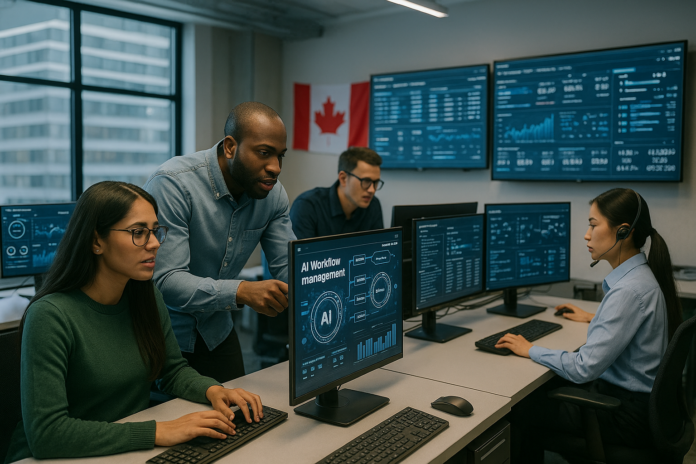
As Canadian enterprises increase their investment in artificial intelligence, the practical adoption of AI agent orchestration frameworks has emerged as a critical step for scalable and effective AI implementation. These frameworks are shifting how businesses manage large-scale AI workflows, address governance challenges, and leverage both proprietary and open-source solutions for sustained value across industries.
Understanding AI Agent Orchestration Frameworks in Enterprise Context
AI agent orchestration frameworks provide the infrastructure to coordinate autonomous AI agents—discrete software components that handle tasks such as data processing, workflow automation, or compliance monitoring. For Canadian organizations navigating regulatory complexities and market competition, orchestration is essential to connect individual capabilities into cohesive, governed, scalable systems.
In practice, orchestration frameworks manage the lifecycle of agents, synchronize activity across distributed systems, and provide interfaces to monitor, intervene, or adapt processes in real time. The promise: reduce manual oversight, ensure auditability, and streamline enterprise AI implementation.
Key Players: OpenClaw, CrewAI, LangGraph, AutoGen, and OpenHands
Several frameworks are leading the evolution from isolated AI applications to robust, enterprise-grade agent environments:
- OpenClaw: Recognized for strong policy enforcement and comprehensive audit trails, OpenClaw accommodates the risk management and compliance needs common among Canadian critical infrastructure sectors.
- CrewAI: With a focus on modularity, CrewAI enables dynamic teams of agents to collaborate or compete, supporting advanced workflow branching and scenario testing.
- LangGraph: Engineered for seamless integration, LangGraph excels in connecting language models and specialized agents within complex enterprise data pipelines, making it valuable for real-time reporting and cross-departmental automation.
- AutoGen: This open-source solution prioritizes ease of customization, offering enterprises a flexible foundation for both experimental and production-grade AI integrations.
- OpenHands: OpenHands is designed for regulated industries, incorporating robust access controls and granular workflow permissions.
Enterprise AI Implementation: Challenges and Solutions
Enterprises embracing orchestration frameworks must address unique operational, security, and governance demands. Regulatory capture—the way major technology vendors sometimes influence rules for industry benefit—can complicate open adoption and increase pressure on Canadian enterprises to justify architecture choices. Orchestration frameworks offer a way to operationalize compliance, as they centralize agent monitoring, decision logging, and workflow management in alignment with policy requirements.
Open-source AI solutions such as AutoGen and CrewAI further enable transparency, rapid prototyping, and adaptability. This can be especially important for Canadian firms seeking to build future-proof, vendor-neutral AI infrastructure. Integration with existing IT and operational technology (OT) systems remains a key consideration, particularly for critical infrastructure and sectors subject to the oversight of entities like the Canadian Centre for Cyber Security.
AI Workflow Management: Orchestrating at Scale
True value from AI agent orchestration frameworks materializes in enterprise workflow management. By automating task assignment, hand-offs, escalation, and collaboration between agents, frameworks minimize human intervention and maximize process efficiency. Real-time dashboards, exception monitoring, and automated compliance checks become standard features. This not only accelerates AI-driven transformation but also provides Canadian organizations with the tools needed to meet evolving governance standards.
Furthermore, for sectors managing sensitive data—such as finance, healthcare, and energy—frameworks like OpenClaw and OpenHands introduce layered access controls and segregation of duties, ensuring security is integrated by design.
Open-Source AI Solutions and Enterprise Flexibility
Openness and flexibility rank high among Canadian enterprise priorities. Open-source orchestration tools reduce vendor lock-in, accelerate innovation, and appeal to organizations with unique integration requirements or heightened data sovereignty needs. Frameworks such as AutoGen and CrewAI, governed by active developer communities, are frequently updated to reflect real-world operational feedback and the shifting compliance landscape.
FAQ
- What is AI agent orchestration?
AI agent orchestration is the coordination of multiple autonomous software agents, managed by specialized frameworks, to fulfill complex business tasks efficiently and reliably at scale. - How are AI agents used in enterprise settings?
AI agents automate and optimize processes like data analysis, customer interaction, IT operations, and regulatory compliance, enhancing productivity and workflow reliability in large organizations. - Which frameworks support AI agent orchestration?
OpenClaw, CrewAI, LangGraph, AutoGen, and OpenHands are among the most recognized frameworks supporting AI agent orchestration for enterprise environments.
Conclusion: Charting a Course for Enterprise Success
As Canada’s enterprises adopt AI agent orchestration frameworks, they position themselves to meet the dual mandates of operational agility and rigorous governance. Evaluating and deploying the right mix of open-source and commercial tools, while maintaining oversight and transparency, will be key for organizations pursuing scalable AI-driven outcomes.