
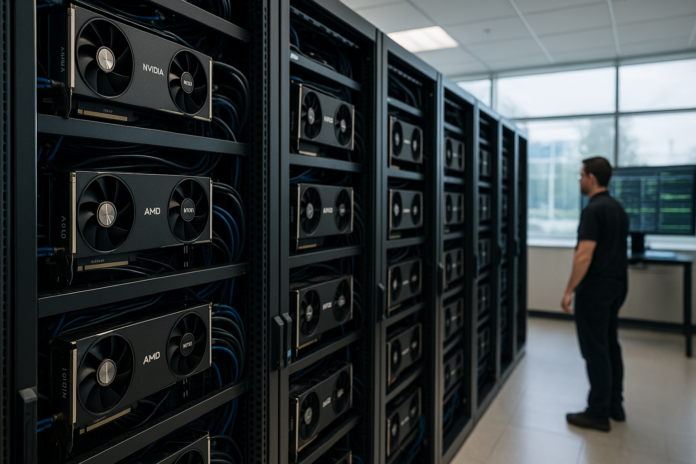
GPU limitations in local AI have become a central concern for enterprises and organizations deploying advanced artificial intelligence workloads outside the cloud. While graphics processing units designed by NVIDIA, AMD, and Intel have long driven rapid progress in machine learning, a closer look at hardware constraints and VRAM economics reveals a more complex picture for enterprise AI planning.
Understanding GPU Limitations in Local AI
GPU technology continues to power record advancements in AI inference systems globally, but the underlying challenges with local deployment persist. For organizations seeking to run large language models or computer vision applications in-house, GPU hardware often emerges as the first—and sometimes largest—barrier.
The most immediate challenge is VRAM capacity. High-performance inference demands significant memory, yet even top-tier GPUs often cap out at 24-48GB of VRAM, restricting the size and complexity of models that can be hosted locally. Moreover, GPUs with higher VRAM command a substantial premium, making cost-for-capability a constant strategic consideration. This links directly to the secondary keyword: VRAM economics. The rush for high-capacity HBM (High Bandwidth Memory) has inflated prices, directly impacting the bottom line for enterprises exploring on-premises options over renting cloud AI capacity.
Enterprise AI and the Cost of VRAM
Beyond acquisition costs, the economics of VRAM extend into operational and opportunity costs for businesses. As reported across the AI infrastructure sector, demand from major cloud providers continues to outstrip supply, reinforcing market dominance for companies like NVIDIA. This ‘arms race’ for hardware places even more strain on enterprises and Canadian organizations hoping to build or expand local AI.
AI inference systems that outgrow single-GPU memory requirements often face diminishing returns with multi-GPU scaling. Data parallelism introduces complexity, increases engineering overhead, and can leave smaller teams at a disadvantage compared to hyperscalers. The larger the model or the dataset, the less viable current generation GPUs can be for discrete, on-prem workloads.
Even for tasks within a GPU’s VRAM limits, performance optimization remains a challenge. Not all inference workloads can fully utilize all available cores, and software dependencies may limit portability between vendors like NVIDIA (with its CUDA ecosystem), AMD, and Intel. For Canadian enterprises, this tight coupling to specific hardware also raises supply chain and long-term support concerns.
AI Hardware Alternatives: Incremental Gains or Paradigm Shift?
Given the entrenched limitations—cost, VRAM, scalability—organizations are exploring alternatives to mainstream GPUs. ASICs and FPGAs, as well as specialty AI accelerators, promise targeted efficiency but usually lack the robust ecosystem and developer tools that make GPUs attractive. Intel and AMD continue to advance their competitive products, yet the software gap remains an adoption hurdle, particularly for smaller Canadian firms with fewer resources for hardware adaptation.
There are also questions about the long-term sustainability of ever-larger, hotter, and more expensive GPUs for local AI inference. Facility power limits, cooling requirements, and ecological considerations can make scaling impractical or undesirable. Furthermore, rapid product cycles from NVIDIA, AMD, and Intel mean that early investment in current-gen hardware may face accelerated obsolescence as new memory and interconnect advances roll out.
Canadian Considerations: Local AI at the Crossroads
For Canadian enterprises focused on digital sovereignty, privacy, or latency, the appeal of local AI is clear. Yet, GPU limitations in local AI present real hurdles that can’t be solved by hardware alone. Strategic planning now involves not just hardware acquisition but also lifecycle management, workload orchestration, and the willingness to reconsider core architectures as new solutions mature.
- Assess current and projected AI workloads before investing in high-end VRAM GPUs.
- Monitor VRAM price changes and hardware roadmaps, especially from NVIDIA, AMD, and Intel.
- Explore hybrid architectures that combine on-prem and cloud AI for maximum flexibility.
- Evaluate emerging accelerators and FPGAs, but recognize software ecosystem constraints.
FAQ
- What are the main challenges with using GPUs for local AI? Key challenges include limited VRAM capacity, high hardware costs, power consumption, and difficulties in upgrading or scaling systems to handle growing AI workloads efficiently.
- How does VRAM cost impact AI deployment? VRAM prices significantly affect deployment decisions, as insufficient VRAM can bottleneck large model inference, forcing organizations to invest heavily in expensive GPUs or limit project scope.
- Are there better alternatives to GPUs? Alternatives such as ASICs, FPGAs, and AI-specific accelerators exist but often lack the broad software support and flexibility of GPUs, making GPU replacement in local AI a complex decision.
Enterprises committed to local AI must weigh the continued advantages of GPUs against their inherent limitations, keeping a vigilant eye on hardware and software advances across the ecosystem. For now, skepticism, flexibility, and careful cost-benefit analyses are essential for anyone seeking to deploy robust AI systems on-premises in Canada or beyond.
Related InsightTrack Analysis
- Google-Blackstone AI Cloud: A Skeptical Look at VRAM Economics
- VRAM Economics in AI Hardware: Security and Cost Analysis
- NVIDIA vs AMD for AI Inference: Performance and Benchmark Analysis
- The Economic Impact of Local AI Inference Workloads for Canadian Enterprises
- Limitations of Commercial AI Agents for Enterprise Use