
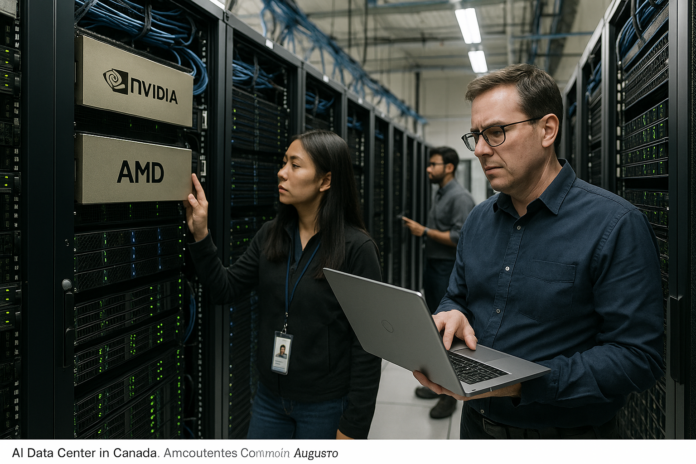
The rapid expansion of AI infrastructure services—such as those driven by Cognizant’s major data center investments—places a premium on robust, scalable hardware for machine learning inference. As enterprises in Canada and globally look to optimize for speed, efficiency, and scalability, the debate of NVIDIA vs AMD for AI inference is moving to the center stage. A careful comparison of GPU performance, AI hardware benchmarks, and integration strategies helps clarify which solution best meets the evolving demands of enterprise AI workloads.
NVIDIA vs AMD for AI Inference: Hardware Ecosystem and Key Differences
When evaluating hardware for AI inference, both NVIDIA and AMD offer specialized GPUs with acceleration capabilities. The NVIDIA A100 and Tesla V100 stand out for their tensor core architectures and pervasive ecosystem. NVIDIA’s software stack, particularly CUDA and cuDNN, is deeply integrated into mainstream machine learning frameworks, providing stable and widely adopted support.
By contrast, AMD’s Radeon Pro VII leverages the ROCm open software platform, and while it delivers competitive hardware, the ecosystem and deep learning framework compatibility are less mature. This can influence developer productivity and model portability across platforms. For organizations that depend on a transparent, open-source approach, AMD has made significant progress but still trails NVIDIA in industry adoption for inference workflows.
GPU Performance and AI Hardware Benchmarks
Under the hood, GPU performance for inference can be measured by throughput (such as images or tokens processed per second), latency for model serving, and energy efficiency. Hardware benchmarks regularly position the NVIDIA A100 at the top tier for modern transformer, vision, and generative AI inference workloads. Benchmarks have shown that the A100’s multi-instance GPU (MIG) capability allows dynamic partitioning of resources, improving inference concurrency and overall TCO for cloud data centers.
The AMD Radeon Pro VII, while competitive in raw compute, performs optimally in specific AI and scientific computing contexts. Present-day software compatibility gaps may create workflow bottlenecks in mainstream deployments—although new ROCm updates have reduced these issues. AMD solutions are often favored in cost-sensitive scenarios or for organizations prioritizing open-source customization.
Enterprise Workload Considerations and Ecosystem Integration
Beyond raw AI hardware benchmarks, enterprise decision-makers must consider software integration, support for proprietary and open-source frameworks, and scaling capabilities. NVIDIA’s GPU lineup remains the preferred choice for large-scale enterprise installations, thanks to a mature driver stack and continued innovation with its deep learning acceleration libraries. The Tesla V100, though now surpassed by the A100 in performance, is still widely deployed due to its stability and compatibility.
Other machine learning accelerators also play a role in this landscape. Google TPU and Intel Nervana Neural Network processors are often considered for specific vertical workloads, offering unique advantages in throughput and model optimization. However, the breadth and depth of NVIDIA’s integration with ecosystem software continue to give it an edge in mainstream inference deployments.
- NVIDIA A100: Leading inference performance, strong ecoystem integration, multi-instance capability
- AMD Radeon Pro VII: Competitive hardware, ROCm support, best value in certain open-source or cost-driven environments
- Tesla V100: Stable, widely supported, still relevant for legacy AI inference stack deployments
- Google TPU / Intel Nervana: Specialized accelerators suitable for select workloads
Impact of Performance Benchmarks on AI Deployment Decisions
For Canadian enterprises and data center operators, hardware selection is shaped by factors beyond technical benchmarks: integration with enterprise AI platforms, support for cloud-native frameworks, and the ability to scale across diverse workloads. Hardware benchmarks offer valuable insights into potential bottlenecks and help balance throughput and energy efficiency against long-term operational costs.
Ultimately, the choice of NVIDIA vs AMD for AI inference is often determined by the maturity of the ecosystem and the organization’s preference for flexibility versus turnkey solutions. As hyperscaler investment continues, supported by significant deal activity such as Cognizant’s expansion, the need for reliable, high-performing AI inference hardware will only intensify.
Frequently Asked Questions
- What are the main differences between NVIDIA and AMD GPUs for AI inference?
The main differences lie in architecture, ecosystem, and framework optimization. NVIDIA has a more mature and integrated stack for AI, while AMD provides compelling open-source options with improving framework support. - Which GPU is better for enterprise AI workloads?
NVIDIA is generally preferred for critical enterprise workloads due to superior performance and software stack maturity, though AMD remains competitive for specific requirements. - How do performance benchmarks impact AI deployment decisions?
Benchmarks influence enterprise choices by highlighting strengths in throughput, latency, and integration across platforms and accelerators like Google TPU and Intel Nervana.
Canadian organizations and global enterprises alike are encouraged to weigh both the hard numbers and the ecosystem support as they plan for next-generation AI deployments in increasingly complex data center environments.
Related InsightTrack Analysis
- GPU Limitations in Local AI Deployments: Hardware Bottlenecks and Economic Realities
- NVIDIA vs AMD for Local AI Inference: BC Data Centre Hardware Analysis
- Economic Impact of Local AI Data Center Development in Canada
- Google-Blackstone AI Cloud: A Skeptical Look at VRAM Economics
- The Economic Impact of Local AI Inference Workloads for Canadian Enterprises