
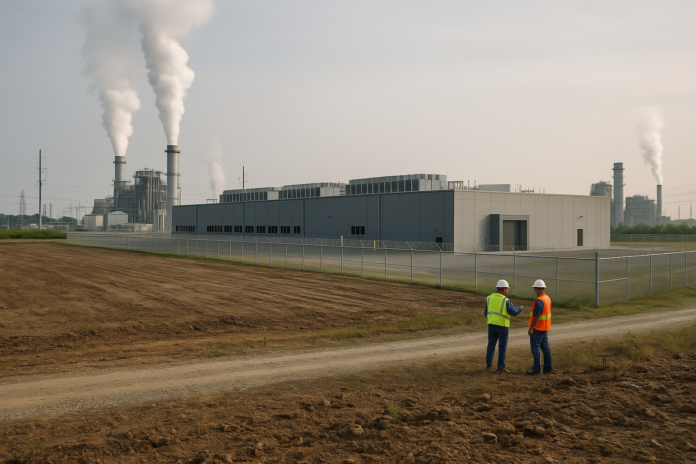
The environmental impact of AI data centers is gaining urgent attention as hyperscale projects like Meta’s Hyperion in rural Louisiana rapidly reshape the sector’s carbon footprint. With artificial intelligence workloads powering everything from recommendations to generative language models, the power demand for data centers has never been higher—and the sustainability of this trend is growing harder to justify under current infrastructure choices.
The Environmental Cost of AI Compute: Hyperion as a Case Study
Meta’s $200 billion Hyperion data center project stands as a potent symbol of the challenges associated with scaling artificial intelligence. Located in rural Louisiana, the facility will deliver 5 GW of AI compute, predominantly powered not by renewables, but by 10 newly built gas-fired power plants from utility partner Entergy. Financing is arranged off Meta’s balance sheet, with Blue Owl Capital handling the $27 billion financing, allowing Meta to push its 2026 capital expenditure to a staggering $145 billion while keeping the burden off direct financial statements.
Gas Power Versus Green AI
The decision to use 10 gas-fired facilities for the bulk of Hyperion’s energy needs raises immediate red flags for those concerned with green AI and sustainable AI infrastructure. Even as the tech sector trumpets sustainability pledges and carbon neutrality goals, gas remains a fossil fuel with significant lifecycle emissions. Every teraflop of AI inference and training handled within Hyperion’s vast racks comes with a quantifiable increase in the carbon footprint of AI.
The carbon intensity of natural gas is lower than coal but considerably higher than renewables or nuclear. It also introduces lifecycle methane emissions, which are potent greenhouse gases. Meta has not released a detailed environmental impact assessment of the Hyperion data center, but industry estimates suggest that data centers powered by fossil fuel plants will greatly exceed the per-megawatt-hour carbon output of those running on wind, solar, or hydroelectric power. The Green AI Alliance and related advocacy bodies emphasize that project finance arrangements—however innovative—do little to address these emissions at their source.
The Trade-off: AI Demand Outpaces Green Infrastructure
The global race to build AI infrastructure is outpacing the deployment of truly sustainable AI infrastructure. Massive investments in hardware and operational technology are prioritized over investment in renewables, sometimes due to grid constraints or the sheer size and immediacy of AI-related workloads. This creates a difficult trade-off: short-term increases in emissions for the sake of long-term digital and economic gains. Critics question whether such decisions are compatible with net-zero ambitions and highlight the need for more robust sectoral regulation and transparency.
- Meta Hyperion: Combines unprecedented AI compute with energy derived almost entirely from new fossil-fuel generation.
- Entergy gas plants: Directly tie local grid capacity increases to emissions-intensive sources, sidestepping transition plans advocated by sustainability experts.
- Blue Owl Capital: Innovative financing ensures corporate flexibility but leaves environmental externalities unchanged.
Rethinking Sustainable AI Infrastructure
The environmental impact of AI data centers is not predetermined; it can be shaped by conscious choices on grid sources, site location, hardware and software optimization, and ongoing operational improvements. Green AI strategies—including those promoted by the Green AI Alliance—encourage building or procuring renewable power directly, deploying high-efficiency hardware, and setting public targets for energy intensity and emissions. For large projects like Hyperion, the ultimate sustainability will be measured less by economic structure and more by real-world climate impact.
FAQ
What is the carbon footprint of Meta’s Hyperion data center?
Meta’s Hyperion facility is likely to have a substantial carbon footprint due to extensive reliance on gas-powered plants; exact numbers are not disclosed but are expected to mirror the emissions profile of large-scale fossil-fueled electricity generation.
How does the use of gas plants affect environmental sustainability in AI?
It increases emissions directly, contradicting the principles of green AI and making environmental targets harder to meet.
Are there more sustainable alternatives to traditional AI infrastructure?
Yes, shifting to renewable energy, optimizing compute, and adopting cutting-edge cooling or grid technologies are among the key approaches considered more sustainable than traditional models.
In conclusion, as the sector stares down exponential AI growth, the environmental impact of AI data centers like Hyperion warrants serious public debate. Industry choices today will shape the true sustainability of tomorrow’s intelligent infrastructure.