
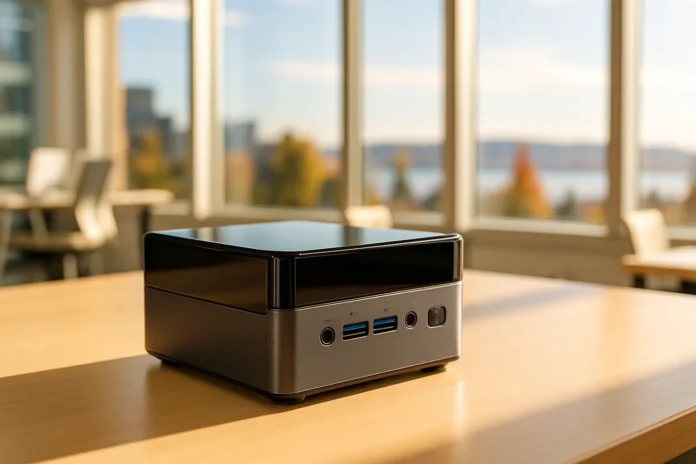
The most consequential AI hardware announcement for Canadian startups this year may not come from Nvidia’s latest GPU launch or a hyperscaler’s new accelerator tier. It may be a $3,999 mini PC built around AMD’s Ryzen AI Max processor — a machine that quietly addresses one of the most persistent friction points in applied AI work: affordable, local, high-memory compute.
What Makes This Machine Different
AMD’s Ryzen AI Max platform — the silicon behind this compact workstation — integrates a high-core-count CPU, a capable GPU, and critically, a large unified memory pool on a single die. Early configurations offer up to 128GB of unified high-bandwidth memory accessible by both the processor and the integrated GPU simultaneously. That memory architecture is the point. Running large language models locally is less about raw GPU throughput and more about memory capacity and bandwidth. A model that won’t fit in VRAM simply won’t run at usable speeds. At 128GB unified, this machine can comfortably run 70-billion-parameter models in quantized form — the class of models that, until recently, required dedicated multi-GPU rigs costing tens of thousands of dollars.
The form factor is a standard mini PC — roughly the size of a hardcover book. No rack space. No specialized cooling infrastructure. No data centre contract required. Plug it into an office, a university lab, or a co-working space, and you have a self-contained inference node.
The Canadian Context
For Canadian AI teams, the calculus here is specific. Cloud compute costs for LLM inference are not trivial, particularly for organizations running iterative research, fine-tuning experiments, or latency-sensitive applications where API round-trips are a liability. A startup in Montreal or Toronto burning through GPU credits on a major cloud provider can easily spend several thousand dollars per month — before any production traffic arrives.
The sub-$5,000 local workstation changes that equation meaningfully. A one-time hardware purchase at $3,999 amortizes quickly against recurring cloud inference costs, particularly for teams with predictable, medium-volume workloads. More importantly, it enables a mode of working that cloud access does not: full data locality.
Data residency is not an abstract concern in Canada. Organizations handling health data, legal documents, financial records, or anything subject to provincial privacy legislation face real compliance friction when sending data to U.S.-based cloud endpoints — even when those providers offer Canadian data centre options. A local inference machine eliminates that exposure entirely. The data never leaves the building.
Who This Actually Serves
It would be easy to overstate the case. This is not a training machine. Fine-tuning large models at scale still requires purpose-built GPU infrastructure. But inference — the act of running a trained model to generate outputs — is where most applied AI work actually happens day-to-day, and inference is exactly what high-unified-memory compact hardware handles well.
The practical beneficiaries in the Canadian ecosystem are fairly easy to identify:
- University research labs at institutions like Mila, the Vector Institute, or the Alberta Machine Intelligence Institute that need local compute for privacy-sensitive research datasets but don’t have capital budgets for GPU clusters.
- Early-stage startups building vertical AI applications — in legal tech, health tech, or professional services — where data sensitivity requires on-premise processing before any cloud deployment is considered.
- Government and public-sector innovation units exploring AI-assisted document processing or internal knowledge retrieval, where data sovereignty is a procurement requirement rather than a preference.
- Regional tech companies outside major metros that lack reliable, cost-effective access to cloud GPU capacity and are looking for deployable local nodes.
The Sovereign AI Angle
Canada’s federal government has made sovereign AI infrastructure a stated policy priority — the logic being that dependence on foreign-controlled compute creates strategic vulnerability. Most of that conversation has focused on large-scale data centre investment and national compute access programs. But sovereignty is not only a national infrastructure question. It is also an organizational one.
A Canadian company that runs its AI inference locally, on hardware it owns, with models it controls, has a form of operational sovereignty that no cloud contract can fully replicate. The $3,999 AMD workstation is not a policy instrument. But it is a practical tool that moves that outcome within reach for organizations that previously faced a binary choice between expensive cloud dependence and prohibitively costly on-premise GPU hardware.
Limitations Worth Naming
The integrated GPU in the Ryzen AI Max platform is not competitive with discrete accelerators for throughput-intensive workloads. Organizations running high-concurrency inference — serving hundreds of simultaneous users — will still need purpose-built infrastructure. The machine also runs warmer than its compact chassis might suggest under sustained AI workloads, and thermal management in small office environments deserves consideration.
Software support for AMD’s AI stack, while improving, remains less mature than the Nvidia CUDA ecosystem. Teams accustomed to CUDA-optimized tooling may encounter friction when configuring model runtimes on AMD hardware, though frameworks like llama.cpp and Ollama have made significant strides in cross-platform support.
The Bottom Line
AMD’s Ryzen AI Max mini PC is not a revolution. It is a practical step-change in the accessibility of capable local AI compute. For Canadian startups and research organizations navigating the gap between cloud dependency and enterprise GPU investment, it represents a credible and newly affordable middle path — one that takes data sovereignty and operating cost control seriously at the same time. That combination, at under $4,000, is worth taking seriously.
Related InsightTrack Analysis
- AI Agent Orchestration Frameworks for Workflow Automation
- Agentic AI Benefits and Risks for Canadian Enterprises
- Local AI Deployment in Canada: Business Benefits
Source
AMD’s most exciting AI machine this year isn’t a GPU — it’s a $3,999 mini PC