
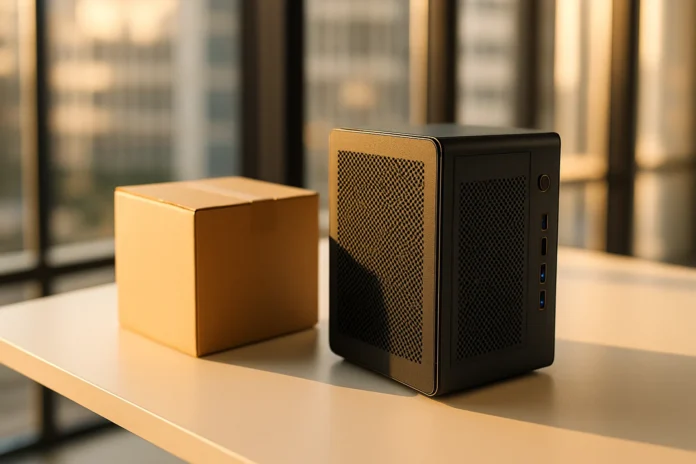
The most consequential AI hardware story of 2024 might not involve a data centre, a rack-mounted GPU, or a billion-dollar chip order. It might be a small box that sits on your desk and costs less than a used car.
AMD’s Strix Halo APU — the silicon at the centre of a new wave of high-performance mini PCs priced around $3,999 — is drawing serious attention from developers and AI practitioners who are tired of routing every inference request through a cloud API. The device represents something more than a spec bump. It’s a proof point for a different model of AI compute entirely.
What Makes Strix Halo Different
The core insight behind the excitement is architectural. Strix Halo is an APU — an accelerated processing unit — that combines CPU cores and a GPU on a single die, sharing a unified memory pool. In the highest configurations, that pool reaches 128GB of LPDDR5X RAM accessible by both the processor and the graphics engine simultaneously.
That matters enormously for local AI inference. Large language models are, fundamentally, memory-bandwidth problems. Moving model weights between discrete GPU VRAM and system RAM is a bottleneck that plagues conventional desktop AI setups. Unified memory eliminates that bottleneck. The CPU and GPU see the same memory space, which means a model loaded into RAM is immediately available to the inference engine without costly data transfers across a PCIe bus.
The practical result: Strix Halo systems can run models that would otherwise require a dedicated GPU with 24GB or more of VRAM — comfortably, locally, and without cloud dependency.
The Inference Economics Are Shifting
For the past two years, the dominant narrative around AI compute has been scaling — bigger models, bigger clusters, more GPUs. That narrative is real, but it obscures a parallel trend that is arguably more relevant to most practitioners: the rapid improvement in quantized, efficient models designed specifically for local deployment.
Models like Mistral, LLaMA 3, Phi-3, and Qwen have demonstrated that capable, task-specific inference is achievable at 7B to 34B parameters with aggressive quantization. A Strix Halo system with 128GB of unified memory can run a Q4-quantized 70B model with reasonable throughput — something that was effectively impossible on consumer hardware twelve months ago.
The cost calculus is straightforward. A single $3,999 mini PC, amortized over three years, costs roughly $110 per month. For a small development team running thousands of inference calls daily against a commercial API, that payback period can be measured in weeks, not years. Add data sovereignty concerns — particularly relevant for Canadian enterprises operating under PIPEDA or provincial privacy frameworks — and the on-premise case becomes more compelling still.
Why This Matters for Developers and Small Teams
The developer community has responded to unified memory architectures with genuine enthusiasm, and not just for cost reasons. Local inference changes what’s possible in a workflow.
- Latency drops from hundreds of milliseconds to tens, enabling real-time applications that cloud round-trips make impractical.
- Data never leaves the machine, which matters for legal, medical, and financial use cases where sensitive information cannot be transmitted to third-party servers.
- Model customization — fine-tuning, prompt engineering at scale, repeated experimentation — becomes frictionless when you’re not paying per token.
- Offline capability becomes trivially achievable, which matters for field deployments, air-gapped environments, and regions with inconsistent connectivity.
For Canadian developers and small AI teams in particular, these factors intersect with a regulatory environment that is increasingly attentive to data residency. Bill C-27, still working through Parliament, and existing provincial frameworks create real compliance pressure around where data is processed. A local inference setup answers those questions definitively.
The Competitive Landscape
AMD is not alone in this space. Apple’s M-series chips have made unified memory a selling point for years, and the Mac Studio with M2 Ultra has been a popular local inference platform among developers willing to work within Apple’s ecosystem. The difference with Strix Halo is that it brings comparable architectural advantages to the Windows and Linux environments where most enterprise and developer tooling lives — and at a price point that undercuts Apple’s high-memory configurations.
Nvidia’s discrete GPU dominance in training workloads is unlikely to be threatened by APUs. But inference is a different market with different constraints, and that market is large and growing. The rise of agentic AI workflows — where a single user request might trigger dozens of model calls across a pipeline — makes local, low-latency inference more valuable, not less.
The Broader Signal
The excitement around a $3,999 mini PC is not really about the device itself. It’s about what the device represents: a moment where edge AI compute has become genuinely capable, genuinely affordable, and genuinely practical for organizations that are not hyperscalers.
The shift toward unified memory architectures — whether from AMD, Apple, or future entrants — is likely to accelerate as model efficiency continues to improve and as regulatory pressure around data sovereignty increases globally. The data centre is not going away. But the assumption that serious AI inference requires one is quietly becoming obsolete.
For developers evaluating their infrastructure stack, the question is no longer whether local inference is viable. It’s whether the workload justifies the cloud.
Related InsightTrack Analysis
- AI Agent Orchestration Frameworks for Workflow Automation
- Agentic AI Benefits and Risks for Canadian Enterprises
- Local AI Deployment in Canada: Business Benefits
Source
AMD’s most exciting AI machine this year isn’t a GPU — it’s a $3,999 mini PC