
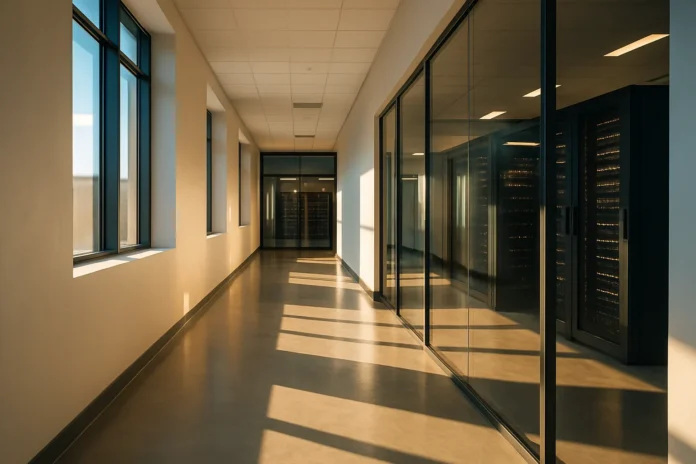
Every conversation about the AI infrastructure boom eventually arrives at the same noun: GPUs. Nvidia’s order books, TSMC’s foundry capacity, hyperscaler capital expenditure — these are the metrics the market watches. But there is a less glamorous constraint accumulating quietly in the background, one measured not in teraflops but in megavolt-amperes: the availability of high-voltage transformers and grid interconnection equipment.
Power Before Compute
A data centre, at its core, is an exercise in power delivery. Before a single GPU processes a single token, electricity must travel from a transmission grid, step down through one or more transformer stages, and distribute cleanly across a facility that may draw anywhere from 50 to 500 megawatts. The compute layer gets the headlines. The electrical infrastructure layer gets the purchase orders — and increasingly, the long lead times.
Large power transformers, the kind required to interconnect a hyperscale campus to a regional grid, currently carry delivery backlogs measured in years, not months. The same supply squeeze affecting transmission infrastructure broadly has migrated downstream to the distribution and medium-voltage equipment that data centres specifically require. Manufacturers who can actually deliver — on time, at scale, to spec — occupy a structurally advantaged position that has little to do with AI hype cycles and everything to do with industrial capacity that took decades to build.
The Canadian Angle
Canada’s exposure to this dynamic is meaningful. The country is an increasingly attractive destination for data centre investment for several intersecting reasons: relatively low-cost and clean electricity in provinces like Quebec and British Columbia, cooler ambient temperatures that reduce mechanical cooling costs, and a regulatory environment that, while not frictionless, is navigable for large infrastructure projects. Microsoft, Google, and a range of AI-native companies have announced or expanded Canadian data centre footprints in recent years.
That demand creates a domestic procurement opportunity for Canadian electrical equipment manufacturers. Companies operating in the power transformer, switchgear, and grid interconnection space — industries that predate AI entirely — find themselves suddenly relevant to some of the largest capital deployment decisions in the technology sector. The investment thesis is straightforward: the buildout cannot proceed without their product, and their product is hard to scale quickly.
Why This Constraint Is Stickier Than the Chip Shortage
The semiconductor shortages of 2020 to 2022 were painful but ultimately resolved through a combination of capacity expansion, demand normalization, and supply chain adaptation. Grid hardware is structurally different. Building a new transformer manufacturing facility requires specialized labor, long-lead raw materials including grain-oriented electrical steel, and capital investment cycles measured in years. There is no equivalent of a fab technology leap that suddenly doubles output per unit of factory floor.
This creates a durable bottleneck dynamic. Even as Nvidia continues to ramp Blackwell production and hyperscalers commit to increasingly aggressive GPU deployment timelines, the electrical infrastructure required to power those GPUs faces a supply curve that cannot respond with the same velocity. A data centre that receives its servers on schedule but cannot energize the facility due to transformer backlog is not a functioning data centre — it is an expensive warehouse.
What Investors Are Watching
The investment logic here is not about picking winners in the AI model race. It is about identifying companies that sit at a genuine physical chokepoint in a capital-intensive buildout with highly visible, multi-year demand signals. Hyperscalers have published capital expenditure guidance that collectively implies hundreds of billions in infrastructure spending annually through the late 2020s. A meaningful fraction of that spending flows to electrical equipment suppliers — and the suppliers with existing manufacturing capacity, certified product lines, and established utility relationships have a meaningful moat.
Canadian manufacturers in this space benefit additionally from proximity to a domestic market with strong data centre tailwinds, as well as from trade considerations that increasingly favor North American sourcing for critical infrastructure components. The push toward supply chain resilience in the post-pandemic period has made buyers more willing to pay a modest premium for reliable, local delivery over the lowest-cost offshore option.
The Broader Implication
The $1 trillion data centre buildout narrative is real, but it risks being misread as a pure semiconductor story. The physical plant required to house and power AI compute is itself a massive procurement exercise, and it draws on industrial supply chains that operate on very different timescales than chip design cycles. Investors and analysts who focus exclusively on the compute layer may be underpricing the companies that make the buildout physically possible.
Grid hardware is not a exciting sector. It does not generate conference keynotes or viral product launches. But in an era where AI ambition routinely outpaces infrastructure reality, the companies that can energize the facilities may prove just as consequential — and just as profitable — as the companies filling them with silicon.
Related InsightTrack Analysis
- AI Agent Orchestration Frameworks for Workflow Automation
- Agentic AI Benefits and Risks for Canadian Enterprises
- Local AI Deployment in Canada: Business Benefits
Source
1 Canadian Company Set to Soar From the $1 Trillion Data Centre Buildout | The Motley Fool Canada

