
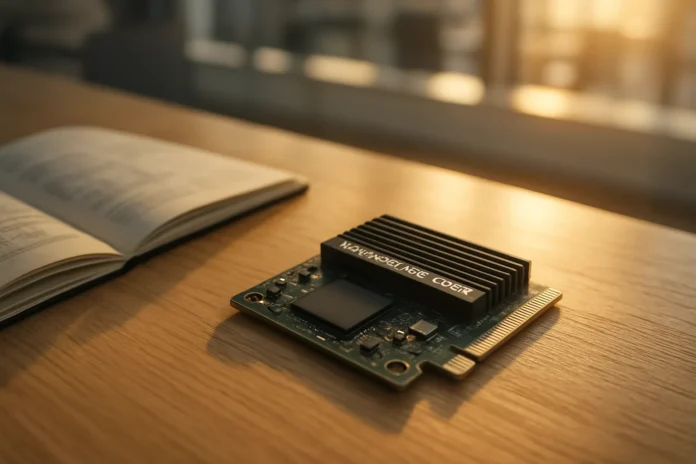
The conversation about AI compute tends to default to the obvious: GPU clusters, hyperscale data centres, and the billion-dollar infrastructure bets being placed by Microsoft, Google, and Amazon. But a quieter shift is underway at the opposite end of the hardware spectrum — inside the M.2 slot.
What M.2 Accelerators Actually Are
The M.2 form factor was designed for storage. NVMe SSDs popularized the slot, turning it into a standard fixture on virtually every modern motherboard, mini-PC, and edge server. AI accelerator cards now exploit that same interface — specifically the PCIe lanes behind it — to deliver dedicated neural processing capability without requiring a discrete GPU or a PCIe expansion card.
Current M.2 AI accelerators from vendors including Hailo, Kneron, and Intel (via the Movidius lineage) are delivering up to 26 TOPS (tera-operations per second) in a footprint roughly the size of a stick of gum, drawing between 1 and 5 watts under load. That TOPS-per-watt density is the operative metric here — not raw throughput, but compute efficiency in constrained environments.
Why Form Factor Matters for Architecture
The significance of M.2 isn’t just physical convenience. It’s about where AI inference can now economically and practically live.
Traditional inference deployment has followed a straightforward pattern: applications call APIs, requests travel to cloud endpoints, results return. This model works when latency is tolerable, bandwidth is available, and the economics of shared cloud compute make sense. It breaks down at the edge — in manufacturing floors, retail environments, medical devices, vehicles, remote infrastructure, and any scenario where connectivity is intermittent or data sovereignty is a hard requirement.
M.2 accelerators change the calculus by making it viable to run capable inference workloads on hardware that’s already present. An industrial PC running process monitoring software almost certainly has an available M.2 slot. A compact server at a Canadian telecom’s edge node has one. A ruggedized system deployed in an Alberta oil field operations centre has one. Dropping in a dedicated AI accelerator card transforms that existing hardware into a local inference node without a chassis redesign or a significant power budget increase.
The TOPS Number in Context
26 TOPS sounds impressive in isolation but requires context. A modern flagship smartphone neural engine operates in the 35–40 TOPS range. Nvidia’s H100 delivers roughly 4,000 TOPS for dense matrix operations. So M.2 accelerators are not competing with data centre silicon — they’re serving a fundamentally different role.
The workloads that fit this envelope are real and expanding: object detection, image classification, keyword spotting, anomaly detection, natural language intent classification at the edge, and lightweight transformer inference with quantized models. INT8 and INT4 quantization have made it possible to run compressed versions of capable models — including small language models in the 1–3 billion parameter range — within the memory and compute constraints these cards impose.
The practical ceiling is rising. Model compression techniques, including pruning, quantization-aware training, and knowledge distillation, continue to improve. A workload that required cloud inference two years ago may run adequately on an M.2 accelerator today.
Distributed Inference as an Architecture Pattern
The more interesting architectural implication is what happens when M.2 accelerators are deployed not individually but as part of a coordinated inference mesh. Rather than routing all inference to a central cluster, organizations can distribute workloads across a fleet of edge nodes — each equipped with local accelerators — with a lightweight orchestration layer managing task routing based on latency requirements, data locality rules, and model availability.
This is not theoretical. Industrial IoT deployments, smart building systems, and retail analytics platforms are already running variants of this pattern. The M.2 form factor makes it cheaper and more physically practical to extend that mesh to a wider class of hardware.
For Canadian organizations specifically, this architecture has direct relevance to data sovereignty concerns. Running inference locally — on hardware physically located in Canada — eliminates the ambiguity that comes with cloud inference routed through US-based endpoints. As federal and provincial procurement policies increasingly scrutinize where sensitive data is processed, the ability to deploy credible AI capability on-premises or at sovereign edge nodes becomes a compliance asset, not just a performance optimization.
The Integration Challenge
M.2 accelerators are not plug-and-play in the way consumer peripherals are. Deployment requires driver support, SDK integration (Hailo’s SDK, Intel’s OpenVINO, and similar frameworks), and model conversion pipelines that prepare trained models for the target hardware’s inference runtime. Organizations without ML engineering capacity may find the toolchain friction significant.
There’s also the matter of ecosystem maturity. The M.2 AI accelerator market remains fragmented. Unlike the GPU ecosystem — where CUDA’s dominance creates a relatively unified software target — M.2 accelerator vendors each maintain proprietary toolchains with varying levels of model compatibility and community support. Hailo has made meaningful progress here; others lag.
Where This Is Heading
The trajectory is toward greater integration. Motherboard manufacturers are beginning to ship boards with AI accelerator functionality embedded alongside or integrated into the M.2 controller logic. Qualcomm’s PC-focused NPU push, Intel’s AI Boost on Core Ultra, and AMD’s XDNA architecture on Ryzen AI all signal that discrete M.2 accelerators may eventually be unnecessary on client hardware — the capability will simply be present.
For server and edge infrastructure, however, the discrete M.2 accelerator card will remain relevant precisely because it enables capability upgrades on existing deployed hardware. In environments where hardware refresh cycles run five to ten years, the ability to add 26 TOPS of inference capacity through a single card insertion is operationally significant.
The M.2 slot started as a storage interface. It’s quietly becoming one of the more consequential locations in the AI infrastructure stack — not because of what any single card can do, but because of how many of them can be deployed, and where.
Related InsightTrack Analysis
- AI Agent Orchestration Frameworks for Workflow Automation
- Agentic AI Benefits and Risks for Canadian Enterprises
- Local AI Deployment in Canada: Business Benefits